
Adobong Puti- Filipino Old Style White Adobo
As an Amazon Associate and member of other affiliate programs, I earn from qualifying purchases.
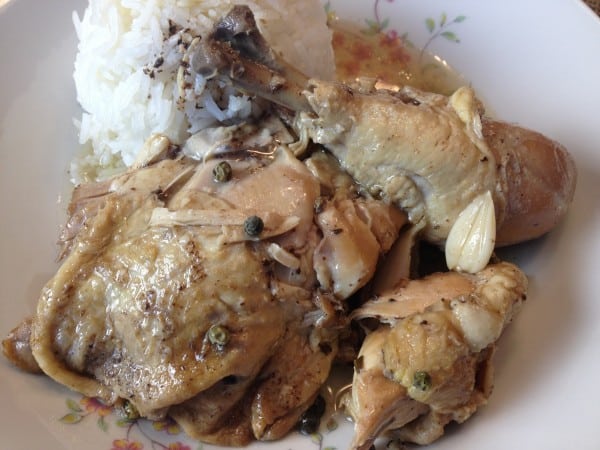
“The real adobo never used ‘toyo’ (soy sauce). And I think it is not just the Visayan version,” was the quick reply from my cousin Manay Lyn who shared this Adobong Puti -Filipino Old Style White Adobo recipe. In Kapampangan, we call this Arobong Maputi. I have my own lifelines when it comes to asking for cooking advice . Most of my resources are my family – my circle of cousins are a big help. I can text questions like this “Is it true the Visayan adobo does not use soy sauce, thus yours is the ‘White Adobo’?”
The most distinct thing my cousin Lyn did, was that the adobo she cooked was white, there was no trace of soy sauce. A few years ago, at my cousin’s beach house here on the east coast, several of us were gathered together for a weekend reunion. My cousin, Manay Lyn Besa Gamboa (‘Manay’ is used to address an older female relative in the Philippines, as a form of respect) was visiting the States from Silay City, Philippines. As we sat around the family dinner table, pouring wine, telling stories, and eating, Manay Lyn occasionally got up from her seat and went to the kitchen stove to the simmering pot. She gave the White Adobo a few stirs, sniffed at the aromatic garlicky-vinegar vapors floating from the pot and exclaimed “Malapit na itong maluto!” (This won’t take long, it will cook soon).
I have cooked white adobo for my family in my New Jersey kitchen regularly. It is a chicken stew pure and simple. It needs a slow simmer for the chicken pieces to get tender, and the ‘adobo’ flavors to set. Adobo has been hailed as the Philippines’ national dish. What makes this one different? The absence of soy sauce makes it unique, but it doesn’t make it any less irresistible. White adobo is just as magnificent in its simplicity and the hard to resist garlic-vinegar flavors. Once cooked till it nearly falls off the bone, the chicken stew has a radiant glistening sheen and very refreshing light flavors. The enormous amount of garlic cooked in the vinegar broth makes this adobo utterly amazing on steamed rice.
For years, my sons were accustomed to seeing regular Filipino Adobo cooked with soy sauce. When I served this White Adobo on the table, I told them why it was so :
“Adobo, which foreigners consider the quintessential Philippine dish, since it is found in all homes, Filipino restaurants at home and abroad, and even in hotels as the token Philippine dish, is based on sour-stewing too : in vinegar, garlic, bay leaves and peppercorn. Soy sauce is a latter-day addition.”(From “Tikim” by Doreen G. Fernandez)
My cousin Lyn was right. White adobo was not just unique to the Visayas, the southern provinces of the Philippines. I found recipes of white adobo, too from the Pampanga region. I found a Kapampangan version, from the Pampanga culinary queen of heirloom cooking, Atching Lillian Borromeo. In her cookbook’s recipe, there was absolutely no trace of soy sauce . The recipe was simple, easy, and cooked by itself once let alone to simmer.
Sometimes, the simplest recipes that have been passed on for generations are arguably the best.
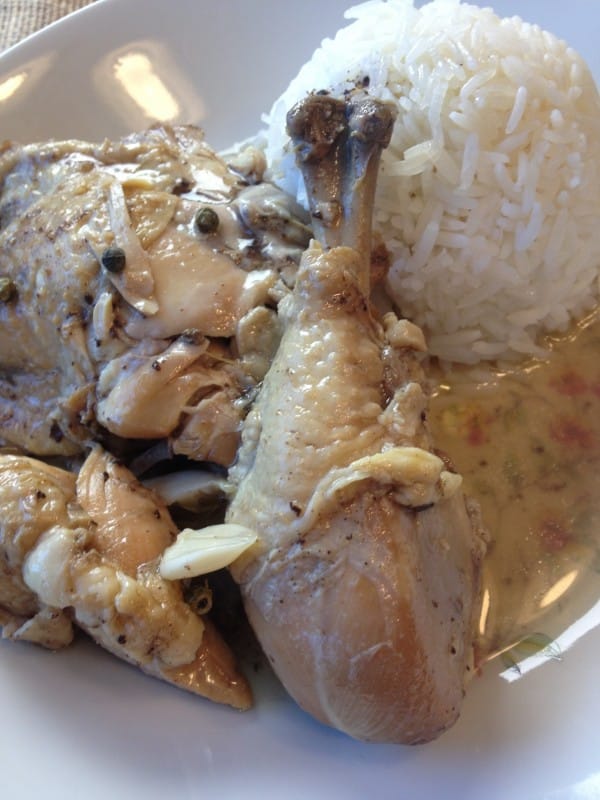
Adobong Puti - Filipino Old Style White Adobo
Ingredients
- 3 pounds chicken, bone-in, skin-on, cut in serving pieces
- 1 cup white cane vinegar or Filipino Sukang Maasim, or use distilled white vinegar
- 2 to 4 cups water enough to cover the chicken
- 8 to 10 cloves garlic about 1 head; chopped, minced
- 3 pieces bay leaves
- 1 teaspoon whole black peppercorns freshly crushed
- 1 teaspoon salt
- 1 teaspoon ground black pepper powder
- steamed rice for serving
Instructions
To cook on the stove-top: (option 1)
- In a large, deep stockpot, over medium-high heat, combine the ingredients together: Chicken, vinegar, water, salt, garlic, bay leaves, black peppercorns, ground black pepper powder. Do not stir yet. Do not cover it.Let the mixture come to a full boil.
- After about 10 minutes, lower heat to a slow simmer. Stir just a little, enough to let the ingredients blend.Continue to simmer over medium to low heat till chicken is tender, for about 1 hour. The sauce will reduce to a thick, translucent gravy by the time the chicken is completely cooked. Serve warm with rice.
To cook in the Instant Pot: (option 2)
- Combine all the ingredients in the inner pot: The chicken, vinegar, water, salt, garlic, bay leaves, black peppercorns, ground black pepper powder. Cover and lock the lid. Set the valve to Sealing.Press Manual and cook on High Pressure for 35 minutes.When buzzer sounds to announce cooking is done, do a Natural Release - let the steam come down on its own. When the float pin drops, it is safe to unlock the lid. Open lid carefully. Use a long cooking spoon or ladle to remove the chicken and sauce. Arrange in a serving platter. Serve warm with rice.
To cook in the Slow Cooker: (option 3)
- Combine all the ingredients inside the slow cooker: Chicken, vinegar, water, garlic, bay leaves, salt, black peppercorns, ground black pepper powder.Cover and set on High. Cook in the slow cooker for 6 hours. At the end of cooking, use a long cooking spoon to take out the chicken and the sauce which would have reduced.Serve warm with rice.
Notes on the Instant Pot:
- For safety precautions, use only accessories recommended for the Instant Pot or multicooker - like metal or silicone. Do not use glassware. Please read the product manual for complete safety instructions.
Nutrition
Nutrition Notes: The nutrition information is an estimate and will vary based on cooking methods and brands of ingredients used.
Did you like this recipe? I have more classic recipes inspired by my late mother’s cooking in my popular cookbook: My Mother’s Philippine Recipes. If you’re learning how to cook Filipino food or a fan of Philippine cuisine, buy my cookbooks and books on Amazon.com sold worldwide in paperback and Kindle format.
Hello, Friends! Please DO NOT LIFT OR PLAGIARIZE my original recipe, stories, photos or videos. All the images and content on this blog are COPYRIGHT PROTECTED and owned by my media company Besa-Quirino LLC. This means BY LAW you are NOT allowed to copy, scrape, lift, frame, plagiarize or use my photos, essays, stories and recipe content on your websites, books, films, television shows, videos, without my permission. If you wish to republish this recipe or content on media outlets mentioned above, please ASK MY PERMISSION, or re-write it in your own words and link back to my blog AsianInAmericaMag.com to give proper attribution. It is the legal thing to do. Thank you. Email me at [email protected]
Disclosure: Instant Pot is the brand name of a multi-cooker that cooks in high and low pressure. I was not paid by the Instant Pot company to mention the product or brand nor endorse it. This is not an ad. My views and opinions are my own.

Dear Betty Ann,
Thanks you for mentioning me in your blog once again. I have an addition to make: I learned from Nancy Reyes Lumen that her lola’s adobo had a sheet of pork skin placed on the bottom of the pot to allow some fat and gelatin to make the adobo sauce even more sucullent. I have tried this and it is divine.
Love, Lyn
Hi Manay Lyn! It’s my pleasure & honor to mention you as a resource. You and all the cousins are my “gurus” in the kitchen, as well as in life, family and love. Thanks for the tip about the pork fat – I shall try that when I cook White Pork Adobo soon. Glad you came by, what a treat to have you blog visit 🙂
ok so i have a confession to make, i’ve never tried adobong puti yet. I remember my mom instructing the helpers to put a little toyo lang because she wants it a little “white” but the helpers fail to remember my mom’s instructions all the time hihi. But ok so for tonight, Ill definitely try this. I will share the photo later to you!
Thanks for the idea for tonight’s dinner.
malou
Hi Malou! I share in your confession – I had been cooking adobo for the longest time with toyo/soy sauce until my cousin made the white adobo version for us. My son asked why I never did it this way, so I was intrigued and tried it. Turns out, it was so enjoyable and delish that now the White Adobo is one of the most requested dishes at our dinner table. Thanks for stopping by – you always make my day with your visit & kind comments!
I’ve never known till now that there is a white adobo version! Looks like the meat is coming off from the bones… yum! I was thinking about making adobo tonight too – funny coincidence. I don’t have the white cane vinegar… otherwise I’d try this one.
Hi Nami! Glad you asked about the White Adobo. In the past, when I ran out of Filipino vinegar and couldn’t go to the Asian supermarket, I substituted white vinegar from Shoprite and it worked out fine. I think if you have enough fresh garlic like I indicated here, and the black peppercorns, then you’ll have a great White Adobo. Thanks for stopping by! Hope you get to try this recipe 🙂
Interesting, I have never seen the white version. I love adobo–I love anything with that much vinegar, truthfully. 🙂
Hi Laura! The combination of garlic on the vinegar and black peppercorns, stewed slowly for a long time was really what made this White Adobo terrific. Thanks for the kind comments and the blog-visit. Always a treat when you stop by 🙂
I made this just as you wrote and it was simply amazing. A long low simmer for two hours had it work our great, a nice savoury unctious sauce with a little tang, plus the garlic and peppercorns mellowed beautifully. Thanks so much for sharing this true heirloom recipe and everyone else, go out and cook it!
Hi Steve! How nice of you to come by the blog! I am so thrilled you liked the recipe for White Adobo. Isn’t it just amazing how the simplest ingredients can make the best dishes? It was great to share this heirloom recipe with you. Thanks for the kind comments 🙂
Hi Betty!
I’m from Panay island and I never had this adobong puti. This looks delish!
I may just have to try this.
Sadly, i will just have to taste it and not eat all of it. I was ordered by the Docs to be serious with my GERD diet from now on.
I enjoy reading your blog.
Thanks for unselfishly sharing all your great recipes.
You inspire me!
Hi Gghie, thanks for the kindest and heartwarming comments. It always makes my day when friends come and blog-visit. I hope you feel better soon. I know what you mean, I had the same condition a few years ago. There may be other dishes on the blog you can enjoy, just go take a look. Thanks & all the best 🙂
Hi Ms. Elizabeth! I just came across your blog because I’ve been looking for good Kapampangan recipes. Thank you for sharing this one – can’t wait to try it out. I understand that it came from Lillian Borromeo’s cookbook – would you know where this can be purchased? Thank you so much!
Hi Nicole! Thanks for the very nice comments which always make my day 🙂 I visited Atching Lillian last May and she is currently re-doing her cookbook. This last one is out of print. The next one will be out soon. I’ll keep my blog readers posted of updates. Meantime, come back to visit the blog because I often cook her recipes and other Capampangan favorites. Manyaman !
Thank you for the swift reply Ma’am! 🙂 will surely be checking your blog every so often. God bless you more!!!
Ok – some additional comment to this white adobo. The Kapampangan does additional step which is really the secret so it does not look so while. After all the stewing before it gets to fall of the bones we take it out set it aside sauté lots of garlic until light golden brown – scope them out because they will burn – proceed to brown chicken on each side- do not crowd the pan once all done – return all chicken to the pan along with the garlic and add little fish sauce and add the reduced sauce and let it boil again – (this is the time where you decide if you want the meat falling of the bone- we do not do that but sny mest we use is still very tender.) Enjoy.
Thanks for the info and next steps for a more flavorful white adobo, Teng. The addition of patis (fish sauce) is also interesting. Good to know all these.
I miss Mom’s Adobong Puti (BTW, she calls it arobo not adobo). Kanyaman (Kasarap in Pampanga) ^_^
Hi Ronnie, I agree with you, they call it ‘arobo’ in Capampangan country 🙂 It is such a great dish, easy to do. Thanks for the blog-visit 🙂
Instead of toyo, one can substitute it for patis (fish sauce).
Thank you for posting this – my family is Ilocano and they make their adobo without soy sauce; this is the only recipe I could find online that sounds similar to the dish I grew up with. I can’t find any restaurants where I live that serve it this way either!
Thanks, Beth. I hope you get to try this Adobong Puti. Believe it or not, since I started cooking adobo without soy sauce, my sons prefer it that way. Enjoy and happy holidays 🙂
How long of time would it take to spoiled?
Thanks, Allane. My Adobong Puti-White Adobo stays in a pyrex refrigerated for 2 weeks. If frozen, the white adobo in a plastic container is good for about 1 month. Hope that helps.
Thanks! This recipe I will use for Halloween party 2015!
I’m going to have a party this Halloween and your recipes are great!
There will be many guests in Halloween costumes, I will decor my house and will prepare great dishes!
Thank you!
Thanks, Barceloc. It’s always nice to hear from friends who want to try my recipes. Enjoy this White Adobo 🙂
SUCCESS!!!!
Thanks for sharing this simple yet sooo delish recipe..
BTW, I added (just) a teaspoon of white sugar!
Better taste…
Thanks again!!!
Marc Tagao (Anaheim)
Thanks, Marc. I’m so glad you enjoyed the Adobong Puti recipe. You made my day 🙂
Just stumbled on this. I add for the collective understanding. When I did my studies in cooking and worked with Filipino chefs, here is what I gathered. As explained to me by a kapampangan chef. ‘Adobo’ (native names have somewhat been lost) is an ancient way of preserving food by cooking in vinegar popular in the islands. The addition of soy sauce was a later development from Chinese influence, bay leaf from the Spanish. The quality and flavor of the dish rested in the type of vinegar used. The chef told me that Adobo sa Puti is a name he never heard as a child and only recently. (Adobo was adobo for him. Tagalogs seasoned theirs with soy whilst the Kapampangan with salt. Soy sauce did not define the dish, the use of vinegar did.) The color of Adobo was the result of the vinegar used so ranged from light (sukang paombong) to brown (sukang iloko). He joked: ‘We don’t cook Adobo sa puti. We cook adobo. The Tagalogs cook Adobo sa toyo.’
I’m Tagalog with my own culinary biases but the man’s explanation and viewpoint makes sense to me. In my own cooking, I try all different types of vinegar from everywhere. One of my Lola used to make pineapple vinegar and use this for Adobo. I know of nowhere in the Philippines making this vinegar anymore. Mexicans though still make proper fermented pineapple vinegar. Something to try.
Thanks, Jojo –I appreciate you took the time to give us your input.